







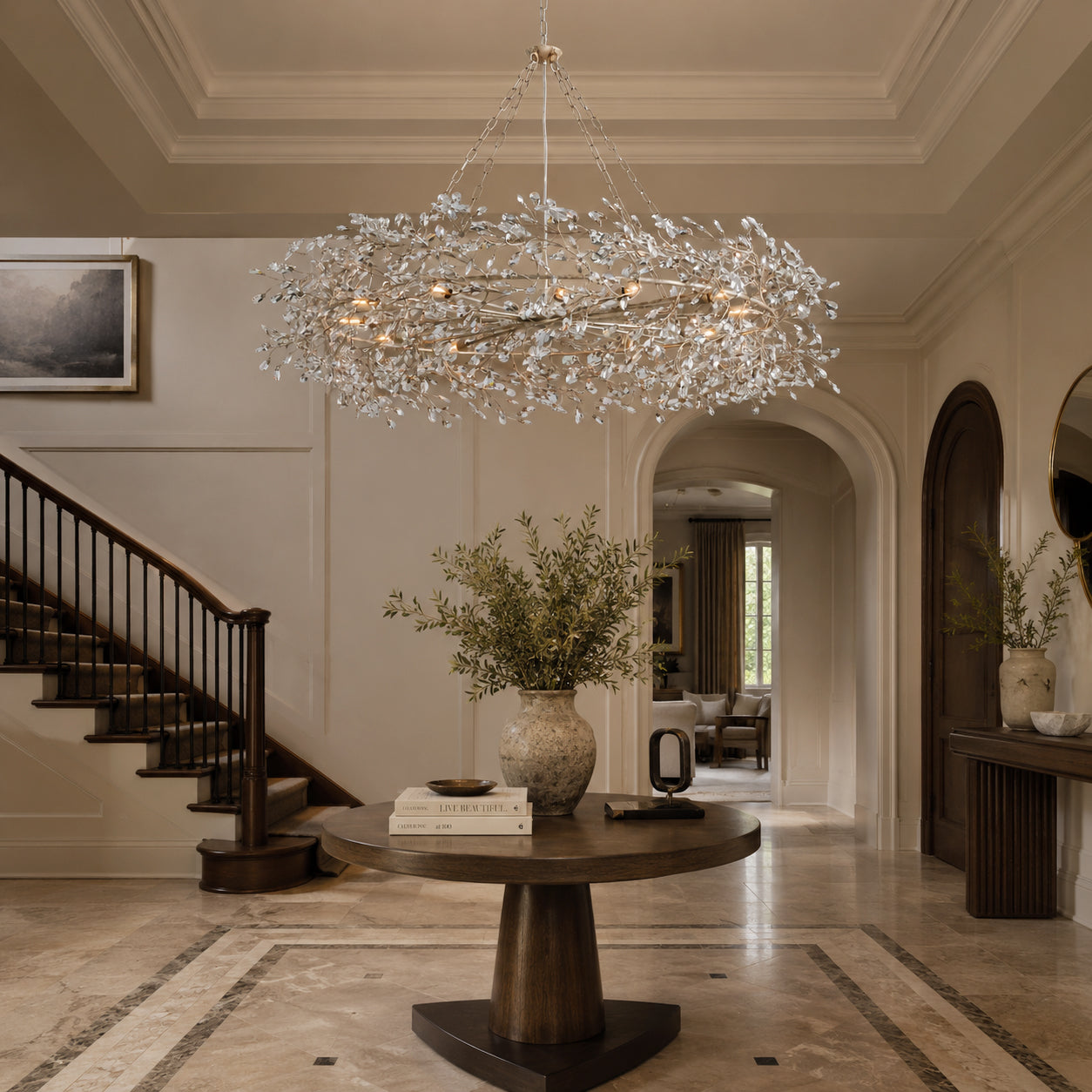

What Is an Alabaster Chandelier? A Buyer’s Guide
Carra Home Lighting Guide
Natural stone, softly illuminated. A closer look at alabaster—and the details that help a beautiful fixture feel right at home.
The quick answer
An alabaster chandelier is a suspended light fixture that uses alabaster stone in its shades, panels, or rings. Its appeal comes from the relationship between stone and light: a pale, sculptural surface by day, and a softly luminous presence when illuminated. Before choosing one, confirm the material, overall proportions, light source, and installation requirements of the exact fixture.

Some lighting draws attention through sparkle. Alabaster invites a closer look. The interest lies in a quiet shift of tone, a vein running through a shade, or the way a familiar shape changes after dusk.
For a considered interior, those details can matter as much as the silhouette. This guide explains what to look for—and which questions to ask before bringing alabaster home.
What is alabaster, exactly?
Alabaster is a stone name with more than one historical meaning. In geology, it refers to a compact, fine-grained form of gypsum. The name has also been used for certain calcite stones, particularly in historical and decorative contexts. The Oxford University Museum of Natural History’s guide to alabaster explains this distinction.
For lighting buyers, the practical question is straightforward: what material is used in this particular shade? A product described as natural alabaster should be distinguished from resin, glass, or a composite made to resemble stone. “Alabaster finish” or “alabaster effect” alone does not establish that a fixture contains natural stone.
Look for an explicit material description, close-up images, and information about the shade construction. If the listing is unclear, ask whether the light-bearing element is natural stone, a veneer, or a manufactured alternative. A photograph can help you understand the appearance; it cannot authenticate the material or establish its mineral composition.
There is no need to conduct a scratch or chemical test at home. Ask for documentation instead.

How does an alabaster chandelier look with the light off and on?
Think of the fixture as having two roles in the room.
With the light off, it is an object. Look at the outline, the relationship between stone and metal, and whether its surface feels comfortable alongside your cabinetry, table, and walls.
With the light on, it becomes part of the atmosphere. Translucent stone can reveal a different balance of pale areas and veining as light passes through it. The result depends on the actual stone, its thickness, the light source, and the surrounding room—not simply the word “alabaster.”
A warm photograph does not establish a fixture’s color temperature. Nor does a softly glowing shade tell you how much useful light will reach the table. Review the specified light source and any published output information separately.
When comparing images, ask for the same fixture shown from the same angle, ideally with similar camera settings and room lighting. A daylight photograph and a heavily edited evening scene can exaggerate the difference.
A Carra example: Lunareth
The Lunareth Alabaster Drum Chandelier pairs a natural alabaster drum with a gold-finished frame. Its listed body measures 31.5 inches wide by 9.8 inches high (80 × 25 cm), and it uses 27 E12 bulbs, sold separately.
Its broad, shallow form offers a useful example of how stone can provide visual presence without a tall, tiered silhouette. Consider both the unlit stone surface and the light you intend to use inside it; bulb selection is part of the finished effect.

What should you expect from natural veining and color variation?
Natural stone does not promise an identical pattern from piece to piece. Carra’s Arica Alabaster Round Chandelier, for example, is described as having variations in shade color and veining.
When reviewing a fixture, consider whether you enjoy that variation as part of the design. If you prefer surfaces with a consistently uniform appearance, discuss that preference before ordering natural stone.
Ask for available close-ups of the actual material, including unlit views. Product photography illustrates an appearance; it does not guarantee the placement of every vein in the piece you receive.
A darker line should not automatically be called a crack, and a visible mark should not automatically be dismissed as natural variation. If something appears chipped, open, loose, or otherwise concerning, photograph it and ask the seller to assess it. An illustration is not an inspection standard.

Which rooms and interior styles suit alabaster lighting?
Alabaster can work in contemporary, transitional, and more traditional interiors. The stronger starting point is the relationship between the fixture and the room—not the style label alone.
Dining rooms: give the shape a purpose
A round drum or ring can gather a dining arrangement around a clear center. A linear fixture can follow the length of an elongated table. Neither is an automatic rule: compare the table’s proportions, the chandelier’s width and depth, and the room’s sightlines.
Center the fixture over the dining table. For a linear design, align it with the table’s long axis. Look at the arrangement from the doorway and from a seated position, where an oversized body or low suspension may feel quite different.

Living rooms: consider the unlit silhouette
In a living room, the chandelier may spend much of the day switched off. Think about its relationship to the seating group, artwork, and ceiling height. A restrained stone form can sit comfortably with textured upholstery and timber; a larger tiered design needs enough visual space around it.
These are styling suggestions, not fixed formulas. Use the actual fixture dimensions to judge the composition.
Kitchens: separate atmosphere from task lighting
For an island, begin with how the surface is used and where the electrical connections are located. A decorative chandelier may contribute atmosphere while additional lighting serves preparation areas. Confirm the fixture’s suitability for the location, and consider how easily its surfaces can be reached for care.
Finishes: look for a relationship, not a perfect match
Our styling approach is to repeat one or two qualities already present in the room: a warm metal tone, a pale stone surface, or a curved outline. There is no need for every finish to be identical. Leaving some contrast often gives the fixture a clearer place in the composition.
What should you check before buying?
Use these six questions to turn an appealing photograph into a considered choice.
- What is the shade made from? Confirm natural stone or another material, its construction, and any available material close-ups. Do not infer stone origin from a collection name.
- Will the complete fixture fit? Check body width and height, canopy dimensions, and minimum and maximum installed drop. Body height alone is not the total hanging height.
- Does the suspension suit the ceiling? Confirm compatibility for the exact model and ceiling slope, along with any required adapter. Ask your installer to assess mounting support using the fixture’s documented weight and instructions.
- How is the light produced and controlled? Establish replaceable bulbs versus integrated LEDs, bulb base where applicable, color-temperature options, and dimmer compatibility. Color-temperature switching is not the same as brightness dimming.
- What will ownership involve? Ask how to clean the stone and metal, access the light source, and obtain replacement components. Follow the fixture’s own care instructions rather than assuming a cleaner suitable for another stone is appropriate.
- What applies to the exact order? Confirm the selected size and finish, included components, delivery estimate, and applicable return or customization conditions before arranging installation.
If color temperature is your next decision, see Carra’s guide to dining room color temperature.
A useful distinction: Lumaire’s lighting controls
The Lumaire Alabaster 2-Tier Ring Chandelier combines alabaster with inner crystal elements and integrated LEDs. The listed ring combinations are 30.7 + 18.9 inches (78 + 48 cm) and 38.6 + 22.8 inches (98 + 58 cm).
Its product page describes wall-switch selection between 3000K, 4500K, and 6000K, and explicitly states that a dimmer switch is not compatible. This is why lighting controls should be checked at product level: choosing alabaster does not tell you whether a chandelier is dimmable.

See the fixture in the context of your home
Begin with one room photograph and a few measurements: ceiling height, table or seating-area dimensions, and the position of the electrical connection. Then shortlist a small number of forms that suit the space.
Explore the Carra alabaster chandelier collection, or use our Design Preview service to consider a selected fixture in your room. The service accepts a room photograph and the product you would like to preview.
A rendering can support a design decision. Final dimensions, installation suitability, and the appearance of the individual stone still need to be confirmed separately.
The right choice should feel considered in daylight and welcoming after dark.
Frequently asked questions
Is an alabaster chandelier made entirely of stone?
Not necessarily. “Alabaster chandelier” generally describes a fixture that incorporates the stone into light-bearing or decorative elements. Its frame, suspension, and other parts may use different materials. Read the component description for the model you are considering.
Is alabaster the same as marble?
The terms are not interchangeable. Geological alabaster is fine-grained gypsum; historical and trade naming can also involve calcite stones. Ask for the specific material instead of relying on a marble-like appearance.
Are all alabaster chandeliers dimmable?
No. Dimming depends on the fixture’s electrical components and compatible controls. Carra’s Lumaire 2-Tier listing, for example, specifies selectable color temperatures but says it is not compatible with a dimmer switch.
Will my chandelier have exactly the same veining as the photograph?
Do not expect exact vein placement in natural stone. Ask what variation to expect and whether images of the available material can be provided, especially if you have a strong preference for a more uniform appearance.
Can alabaster provide all the light a room needs?
The material alone cannot answer that. Check the fixture’s output information, room size, surface finishes, and tasks. Plan additional lighting where needed rather than using a glowing product image as a brightness measurement.
How should I care for an alabaster chandelier?
Request the care instructions for its particular stone, finish, and construction. Do not apply household cleaners, polish, or stain treatments without confirmation that they are suitable. Arrange safe access for cleaning and maintenance.