







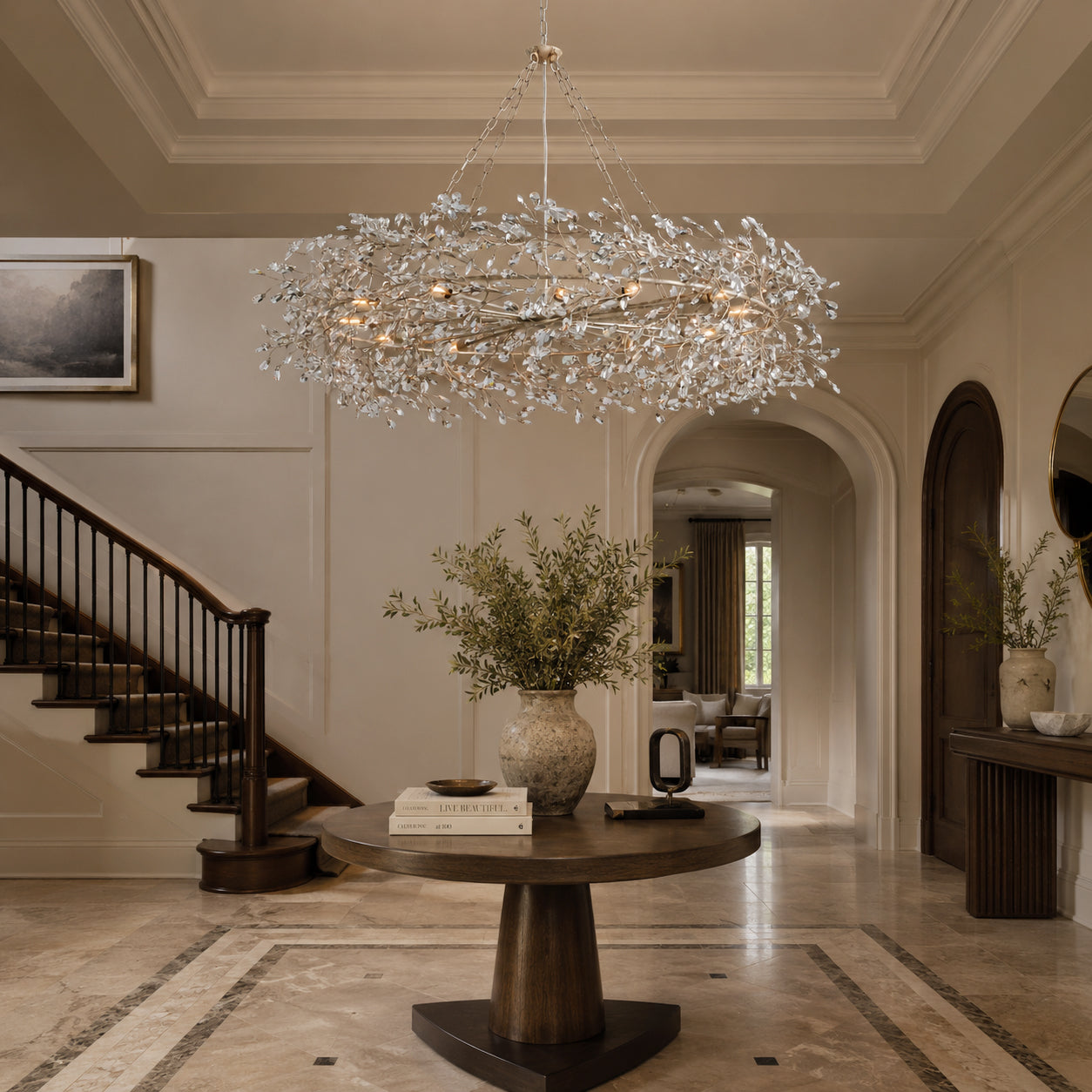

How to Choose the Right Size for Every Room
Quick navigation: General Rules · Dining Room · Kitchen Island · Living Room · Foyer & Staircase · Bedroom · Hallway · Low Ceilings · Quick-Reference Chart · FAQ
Picking the wrong chandelier size is one of the most common — and costly — decorating mistakes. A fixture that looks perfect in the showroom can feel dwarfed in a large living room or overwhelming above a small dining table. The good news: a handful of simple formulas takes most of the guesswork out of it.
This guide covers every major room type with practical formulas, quick-reference tables, and the mistakes to avoid. Whether you're shopping for a dining room chandelier, a dramatic foyer piece, or a subtle bedroom fixture, you'll find what you need here.
1. General Rules That Apply to Every Space
Before diving into room-specific tips, these three universal formulas give you a solid starting point for almost any situation.
Rule 1 — Diameter: Add the Room Dimensions Together
Measure your room's length and width in feet. Add them together. The result in inches is roughly the ideal chandelier diameter.
Room Length (ft) + Room Width (ft) = Chandelier Diameter (inches)
Example: 16 ft + 12 ft = 28 → choose a chandelier ~28" in diameter
Example: 16 ft + 12 ft = 28 → choose a chandelier ~28" in diameter
For rectangular rooms, a rectangular or linear chandelier often works better than a round one — match the chandelier's proportions to the room's proportions.
Rule 2 — Height: Multiply Ceiling Height by 2.5
For pendant-style chandeliers (where visual height matters), multiply your ceiling height in feet by 2.5 to get the ideal chandelier height in inches. Note: this applies mainly to pendant and drop-style fixtures, not flush or semi-flush mounts.
Ceiling Height (ft) × 2.5 = Chandelier Height (inches)
Example: 10 ft ceiling → 10 × 2.5 = 25" chandelier height
Example: 10 ft ceiling → 10 × 2.5 = 25" chandelier height
Rule 3 — Hanging Height: Bottom Clearance from the Floor
How low the chandelier hangs is just as important as its size.
- Open floor (living room, foyer, hallway): The bottom of the chandelier should hang at least 7 feet (84 inches) from the floor — ideally 7.5 ft for comfortable clearance.
- Above a dining table or kitchen island: Bottom of the chandelier should be 30 to 36 inches above the tabletop. For higher ceilings (10 ft+), lean toward 34–36"; for standard 8–9 ft ceilings, 30–32" works well.
💡 Tip: If you're unsure about hanging height, cut a piece of string to the intended drop length and tape it to the ceiling while you visualize the look. Much easier than re-drilling.
2. Dining Room Chandelier Size Guide
The dining room is the most common place for a chandelier, and getting the proportion right matters a lot — the fixture hovers right in everyone's line of sight during meals.
Size It to Your Table, Not Just the Room
The most reliable dining room formula is to size the chandelier relative to the dining table, not just the room dimensions.
Chandelier diameter/length = 1/2 to 2/3 of the table's length
Example: 72" (6 ft) table → chandelier between 36" and 48" wide
Example: 72" (6 ft) table → chandelier between 36" and 48" wide
| Table Length | Recommended Chandelier Width | Chandelier Style |
|---|---|---|
| Under 48" (4 ft) | 18" – 24" | Round or square |
| 48" – 60" (4–5 ft) | 24" – 36" | Round, oval, or linear |
| 60" – 72" (5–6 ft) | 30" – 45" | Linear or rectangular preferred |
| 72" – 84" (6–7 ft) | 36" – 54" | Linear or two-light cluster |
| 84"+ (7 ft+) | 48"+ or two fixtures | Linear or two pendants |
Hanging Height Above the Table
Hang the bottom of the chandelier 30–36 inches above the tabletop. This keeps it in your field of vision without blocking sight lines across the table.
Common Mistakes
- Going too narrow — a 24" chandelier over a 72" table looks lost.
- Hanging too high — above 40" from the tabletop loses the intimate, ambient effect.
- Hanging too low — below 28" from tabletop creates glare and blocks views.
Browse Dining Room Chandeliers →
3. Kitchen Island Chandelier & Pendant Size Guide
Kitchen islands are best served by linear pendants or chandeliers rather than round fixtures — they follow the shape of the island and distribute light more evenly across the workspace.
Chandelier/pendant length = 1/2 to 2/3 of island length
Example: 84" island → 42"–56" linear chandelier
Example: 84" island → 42"–56" linear chandelier
Multi-Pendant Option
If you prefer individual pendants over a single fixture, use this as a guide:
- Space pendants 24–30 inches apart, center-to-center.
- Each pendant should hang 30–36 inches above the countertop.
- Leave at least 6 inches from the outer pendants to the edge of the island.
| Island Length | Single Fixture Width | Multi-Pendant Option |
|---|---|---|
| 36" – 48" | 18"–28" | 1–2 pendants |
| 48" – 72" | 24"–42" | 2 pendants |
| 72" – 96" | 36"–54" | 2–3 pendants |
| 96"+ | 48"–60" or two fixtures | 3 pendants |
Browse Kitchen Island Lights →
4. Living Room Chandelier Size Guide
Living rooms are typically the largest rooms in a home, and they're often where people want to make the biggest design statement. The key is balancing grandeur with comfort — a chandelier that dominates a conversation area feels oppressive rather than impressive.
Use the Room-Dimension Formula
The standard length + width = diameter in inches formula works well for living rooms. However, living rooms tend to be larger, so don't be afraid to go to the high end or even slightly above the formula result.
Example: 20 ft × 16 ft living room → 20 + 16 = 36 → choose a chandelier 36"–42" wide
Consider Ceiling Height Carefully
Living rooms often have 9–12 ft ceilings. Use ceiling height to guide the fixture's vertical scale:
| Ceiling Height | Recommended Chandelier Height | Hanging Clearance |
|---|---|---|
| 8 ft | 4"–8" (flush or semi-flush) | Flush mount recommended |
| 9 ft | Up to 12" | Bottom at 7.5 ft |
| 10 ft | 12"–20" | Bottom at 7.5–8 ft |
| 12 ft | 20"–30" | Bottom at 8 ft |
| 14 ft+ | 30"–48" | Bottom at 8–9 ft |
Placement Tip
If the room has a seating arrangement, center the chandelier over the conversation area (typically the coffee table), not necessarily the geometric center of the room. This creates a more intentional, designed look.
Browse Living Room Chandeliers →
5. Foyer & Two-Story Staircase Chandelier Size Guide
The foyer is a first impression — it sets the tone for the entire home. Two-story foyers in particular demand fixtures with presence: tall, dramatic, and visible from both floors.
Single-Story Foyer
Apply the standard diameter formula, but aim for a taller fixture to fill vertical space:
- Diameter: length + width of foyer (in feet) = diameter in inches
- Hanging height: bottom of chandelier at least 7 feet from the floor
- If the foyer has an 8 ft ceiling, prioritize a semi-flush mount with vertical visual interest
Two-Story Foyer with Staircase
For two-story foyers, a grand chandelier with extended height is often the right call. Consider two key reference points:
- Second-floor sightline: The top of the chandelier should be roughly at eye-level when standing at the top of the staircase — this creates the ideal reveal as you ascend.
- First-floor clearance: The bottom of the chandelier must remain at least 7 feet from the first floor. If the foyer is very tall (18–22 ft), the chandelier can hang lower without compromising headroom.
Typical two-story foyer (18 ft ceiling):
Room diameter formula: e.g., 10 ft + 10 ft = 20" wide minimum
Chandelier height: 36"–60" (to fill vertical space visually)
Drop from ceiling: ceiling height − 7 ft clearance − chandelier height = max rod/chain length
Room diameter formula: e.g., 10 ft + 10 ft = 20" wide minimum
Chandelier height: 36"–60" (to fill vertical space visually)
Drop from ceiling: ceiling height − 7 ft clearance − chandelier height = max rod/chain length
Architectural Centering
Many designers center the foyer chandelier not on the room's geometric midpoint, but on a feature element — the front door transom window, a ceiling medallion, or the center of the staircase landing. This often produces a more polished result than strict geometric centering.
Browse Foyer & Staircase Chandeliers →
6. Bedroom Chandelier Size Guide
Bedrooms call for a different approach than living or dining spaces. You want ambient warmth, not visual drama. Scale down — a chandelier that would feel modest in a living room often feels just right in a bedroom.
Size Formula for Bedrooms
Use the standard room-dimension formula, but apply it conservatively. For a 14 ft × 12 ft bedroom:
14 + 12 = 26 → aim for a chandelier 20"–26" wide (lower end of the range)
Hanging Height in the Bedroom
This is where bedrooms differ most from other rooms. Since you're often looking up from a lying position, hanging height is critical for comfort:
- If the chandelier is centered over the room (not the bed): 7 ft minimum from floor to bottom.
- If it hangs above the bed: the bottom should be at least 7 ft from the floor, or higher if the chandelier has a low-profile design. Never position a sharp or heavy fixture directly over the sleeping area at a lower height.
- For 8 ft ceilings: use a semi-flush or flush mount with chandelier aesthetics instead of a full pendant drop.
| Room Size | Recommended Diameter | Style Suggestion |
|---|---|---|
| 10 × 10 ft (small) | 16"–20" | Mini chandelier or semi-flush |
| 12 × 12 ft (medium) | 20"–24" | Round or square chandelier |
| 14 × 14 ft (large) | 24"–28" | Round chandelier |
| 16 × 16 ft+ (master) | 28"–36" | Statement chandelier |
7. Hallway Chandelier Size Guide
Hallways are narrow by nature, so the width of the hallway — not the length — drives the size of any fixture you choose.
Hallway Width (ft) × 2.5 = Chandelier Diameter (inches)
Example: 5 ft wide hallway → 5 × 2.5 = 12.5" → choose a 12"–14" diameter fixture
Example: 5 ft wide hallway → 5 × 2.5 = 12.5" → choose a 12"–14" diameter fixture
Spacing & Placement for Long Hallways
- Center each fixture in the middle width of the hallway.
- Space multiple fixtures 8 to 10 feet apart along the length of the hallway.
- Maintain at least 7 feet clearance from floor to bottom of fixture.
- For low-ceiling hallways (under 8 ft), opt for flush or semi-flush mounts to preserve clearance.
💡 Tip: In hallways narrower than 4 feet, a single semi-flush mount or a row of small pendants often works better than traditional chandeliers.
8. Chandeliers for Low Ceilings (8 ft or Under)
Standard 8 ft ceilings are one of the most common sizing challenges. Most chandelier drops are designed for 9–10 ft ceilings, which means the fixture can hang too low without adjustment.
Solutions for 8 ft Ceilings
- Semi-flush or flush mount chandeliers: These mount closer to the ceiling and maintain 7+ ft clearance even in low-ceiling spaces. Many have the look of full chandeliers without the drop length.
- Shorten the chain or rod: Most chandelier drops can be shortened. Remove links from the chain or use a shorter canopy rod. Aim for the bottom of the fixture to sit no lower than 7 ft from the floor.
- Foyer exception: If you have an 8 ft foyer, use a semi-flush mount and add visual interest through the fixture's design (crystal, geometric, etc.) rather than vertical scale.
| Ceiling Height | Recommended Approach | Max Drop (to maintain 7 ft clearance) |
|---|---|---|
| 7 ft | Flush mount only | 0" (flush) |
| 8 ft | Semi-flush or short drop | Up to 12" |
| 9 ft | Standard chandelier, shortened if needed | Up to 24" |
| 10 ft | Standard chandelier | Up to 36" |
| 12 ft+ | Grand chandelier, longer drop | Up to 48"+ |
9. Quick-Reference Size Chart
| Room | Size Formula | Hanging Height | Notes |
|---|---|---|---|
| Dining Room | 1/2 to 2/3 of table length | 30–36" above tabletop | Match shape to table shape |
| Kitchen Island | 1/2 to 2/3 of island length | 30–36" above countertop | Linear fixture preferred |
| Living Room | L + W (ft) = diameter (in) | 7.5 ft min from floor | Center over seating area |
| Foyer (single-story) | L + W (ft) = diameter (in) | 7 ft min from floor | Taller fixture fills vertical space |
| Two-Story Foyer | L + W (ft) = diameter (in); tall drop | 7 ft min from first floor | Top at eye level from second floor |
| Bedroom | L + W (ft) = diameter (in), lower end | 7 ft min from floor | Scale down vs. living room |
| Hallway | Width (ft) × 2.5 = diameter (in) | 7 ft min from floor | Space multiple fixtures 8–10 ft apart |
| Low Ceiling (8 ft) | Same formula, scale down | Flush or semi-flush | Max 12" drop from ceiling |
10. Frequently Asked Questions
Q: My dining table is 84" × 42". What size chandelier should I use?Using the 1/2–2/3 rule: 84" × 1/2 = 42", 84" × 2/3 = 56". You'd want a linear or rectangular chandelier42"–54" in length. A round fixture around 36"–42" in diameter could also work if you prefer that style.
Q: I have a 10-foot kitchen island. How many pendants or what size fixture?For a 10 ft (120") island: using the 1/2–2/3 rule, a single linear fixture of 60"–80" would work. Alternatively, use3 pendants spaced 24–30 inches apartcentered over the island, with the outer ones roughly 6" from each end.
Q: My living room has a vaulted or sloped ceiling. How do I measure?Use theaverage ceiling height(add the lowest and highest points, divide by two) as your baseline for the hanging-height calculation. Most chandeliers come with adjustable rods or chains — hang so the bottom clears 7 ft at the lowest ceiling point.
Q: Can I hang a chandelier in a room with only 8 ft ceilings?Yes — use a semi-flush or flush mount style. Shorten any rod/chain so the bottom of the fixture sits no lower than 7 ft from the floor. That gives you up to 12" of drop, which is enough for many chandelier designs.
Q: How do I know if my electrical box can support the chandelier's weight?Standard ceiling electrical boxes are typically rated for fixtures up to35–50 lbs. Heavier chandeliers (foyer pieces can weigh 60–150 lbs) require a fan-rated or special heavy-load box anchored to a ceiling joist or a structural brace bar. When in doubt, consult a licensed electrician before installing.
Q: Should a chandelier above a dining table be centered on the table or the room?Center it over the table, not the room. If your table is against a wall or off-center in the room, the chandelier should follow the table. The visual anchor is the table, not the floor plan.
Q: Can I shorten the chain/rod to make the chandelier hang higher?Yes. Most chandeliers ship with excess chain or a long rod that can be trimmed. For chain: simply remove links. For rod systems: use a shorter rod section. Keep the wire inside the chain/rod long enough to reach the canopy with a few inches of slack. If in doubt, have an electrician do the final trim.
Q: My entryway is very small (6 × 9 ft with a 13 ft ceiling). What should I hang?6 + 9 = 15 → aim for a fixture ~15" in diameter. With a 13 ft ceiling, you have excellent vertical space. A tall, narrow fixture (like a spiral raindrop or tiered crystal chandelier) 30"–48" in height will make the space feel dramatic without overwhelming it. Hang so the bottom is at least 7.5 ft from the floor.
Ready to Find Your Perfect Chandelier?
Now that you know your measurements, browse our collections by room to find the right fit:
- Dining Room Chandeliers
- Kitchen Island Chandeliers
- Living Room Chandeliers
- Foyer & Staircase Chandeliers
- Bedroom Chandeliers
- Gold & Crystal Chandeliers
Still not sure? Email us at support@carrahome.com or use our live chat — our team is happy to recommend the right size for your specific space.